
Nepal's macroeconomic performance has been held back by the earthquakes and the recent unrest and disruptions to transportation and trade routes following the promulgation of a new constitution, the IMF said has said.
.jpg)
The toxic brew of fiscal populism, crony capitalism and bad economic management has ensured the collapse of economic growth, industrial stagnation, stubbornly high consumer inflation, declining savings and investment, shrinking employment opportunities, and a dangerously vulnerable external financing situation.

Reserve Bank Governor Raghuram Rajan on Thursday said the central bank will continue its focus on taming inflation, speeding up resolution of distressed projects and ensuring enough capital for banks through balance sheet clean-up.
India's service sector proportionately much larger than China's, while its investment and industrial-production shares are much lower

In five years, per-employee revenue for IT companies grew at 9 per cent each year.

Four decades of federal evolution made India more secure, but coronavirus is reversing that. Modi's central government has tasted power again and is unlikely to give it up, notes Shekhar Gupta.

Arun Jaitley opted for a fiscal deficit of 3.9% in 2015-16.
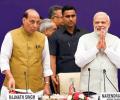
Chief ministers of states like Andhra Pradesh, Kerala and Karnataka were among those who raised the issue of loan waver scheme for farmers.

To attract capital into infrastructure projects, the ratings system needs a fresh look.
Public resources are scarce and need to be used well.

'The government's principal aim should be to reduce the volume of cash transactions.' 'That would bring more of the Indian economy within the purview of taxation.' 'The current downturn in economic activity due to a lack of adequate cash is likely to be limited to a year,'
In advanced economies where the financial system is more matured, the form of shadow banking is more of risk transformation through securitisation.

The report, however, said it remains watchful of the upside risks to inflation emanating from pass-through of minimum support prices (MSPs), adverse movement in crude oil prices, volatility in global financial markets, lagged impact of the rupee weakness on input prices, adverse implications from fiscal slippage and staggered impact of HRA increases by states and its second-round impact.

Some experts had said the Budget did not have much in terms of big ideas.

Also says PSU banks divestment to be considered after improvement in governance

Sinha, a former finance minister, hogged the limelight and started trending high on social media on Wednesday after he criticised his own government for sinking economy in an article.

Should you expect 15 per cent return over a period of 20 years? Dwaipayan Bose has the answer

Raghuram Rajan, who has been pilloried by his critics for keeping interest rates high and has also been accused of stifling growth.

The retail inflation, which is factored in by the RBI to arrive at its monetary policy, has been on decline since last month. The previous low was 5.54 per cent in November 2019. The government has asked the RBI to restrict the inflation around 4 per cent, with a margin of 2 per cent on the either side.

Economic Affairs secretary S C Garg said inflation has consistently come down since 2014 and will not cross 4 per cent this fiscal.

India's credit and banking are neither too big nor too small.

The income tax department estimates total collection to be between Rs 10.5 trillion and Rs 10.7 trillion against the revised target of Rs 11.7 trillion.

'Breaking down silos and ensuring a more integrated governance process is just as important to performance.' 'It has been a major priority in the last six years, especially in national security,' External Affairs Minister Dr Subrahmanyam Jaishankar points out when delivering the Sardar Patel Memorial Lecture-2020: India and the Post-Covid World.
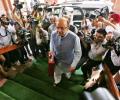
The Budget provides a reassuring message about Prime Minister Narendra Modi staying the course.
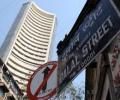
Markets are likely to go down, correct and stay subdued.

Suresh Prabhu is trapped in the 'rhetoric of his own government'.

'If such inflows materialise, what will be the effect on the rupee's value -- and therefore on exports growth, the only sustainable path to recovery?', asks Mihir S Sharma.
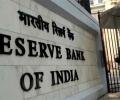
Headed by Urjit Patel, MPC for the fourth straight time kept the repo rate unchanged, at which it lends to the banks, at 6.25 per cent. The reverse repo, at which RBI borrows, will be 6 per cent.

According to the report by the global financial services major, the FY2013-14 CAD is expected to be within $36 billion or 2 per cent of GDP, and this fiscal year CAD is likely to be slightly higher but contained at 2.3 per cent of GDP.

The central bank can directly print money and finance the government, but it should avoid doing so unless there is absolutely no alternative, former RBI governor D Subbarao on Wednesday said while pointing out that India is 'nowhere' near such a scenario. In an interview with PTI, Subbarao suggested that to deal with the second wave of COVID-19 induced slowdown in the economy, the government can consider Covid bonds as an option to raise borrowing, not in addition to budgeted borrowing, but as a part of that.

Indian market probably has more headroom than the US, says Geoff Lewis, senior strategist for Asia, Manulife Asset Management.

'Gloom is nowhere in sight, with healthy foreign exchange reserves, a strong rupee, healthy tax collections, corruption and crony capitalism under check,' argues Gopal Krishna Agrawal.
.jpg)
'India is doing better than when we took office 17 months ago'.

The statement said that the global economy is being held back by a shortfall in demand, while addressing supply constraints is key to lifting potential growth.

Growth in India's gross domestic product for the June quarter of 2013-14, as well as for the entire 2014-15, was 4.7%.

Assessing the shape of the Indian economy just a couple of days ahead of the Union Budget for 2016-17, Saugata Bhatacharya, senior vice president and chief economist, Axis Bank, speaks about his budget wishlist and suggests measures that can help finance minister Arun Jaitley achieve the targeted fiscal deficit of 3.5 per cent of India's gross domestic product.

Global economy will have to grapple with few tough situations in 2015.

For rest of the year, the issue is largely going to be the balance between growth rates and macro stability versus interest rates, says Sankaran Naren.
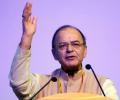
Is the Budget sufficiently prudent? It probably is but at the cost of substantial under-provisioning for the many grand sounding schemes announced in it, says Nitin Desai.

The elements are all aligned to make India a global powerhouse, says IMF Managing Director Christine Lagarde.
 © 2026 Rediff.com - Advertise with us - Disclaimer - Privacy Policy - Sitemap - Feedback - About us - Terms of use - Grievances